AI Video Editing Automation for Broadcasters
The Problem
Broadcast and media teams produce enormous volumes of raw footage daily - press conferences, live events, sports coverage. Manual editing is slow, expensive, and creates bottlenecks when audiences expect rapid turnaround.
A national broadcaster might record 8-12 hours of raw press conference footage per day. Editors manually review this material, identify newsworthy moments, cut clips, and prepare segments for broadcast. Even with experienced editors, this process takes hours per event.
How AI Solves It
AI video editing automation changes this equation fundamentally:
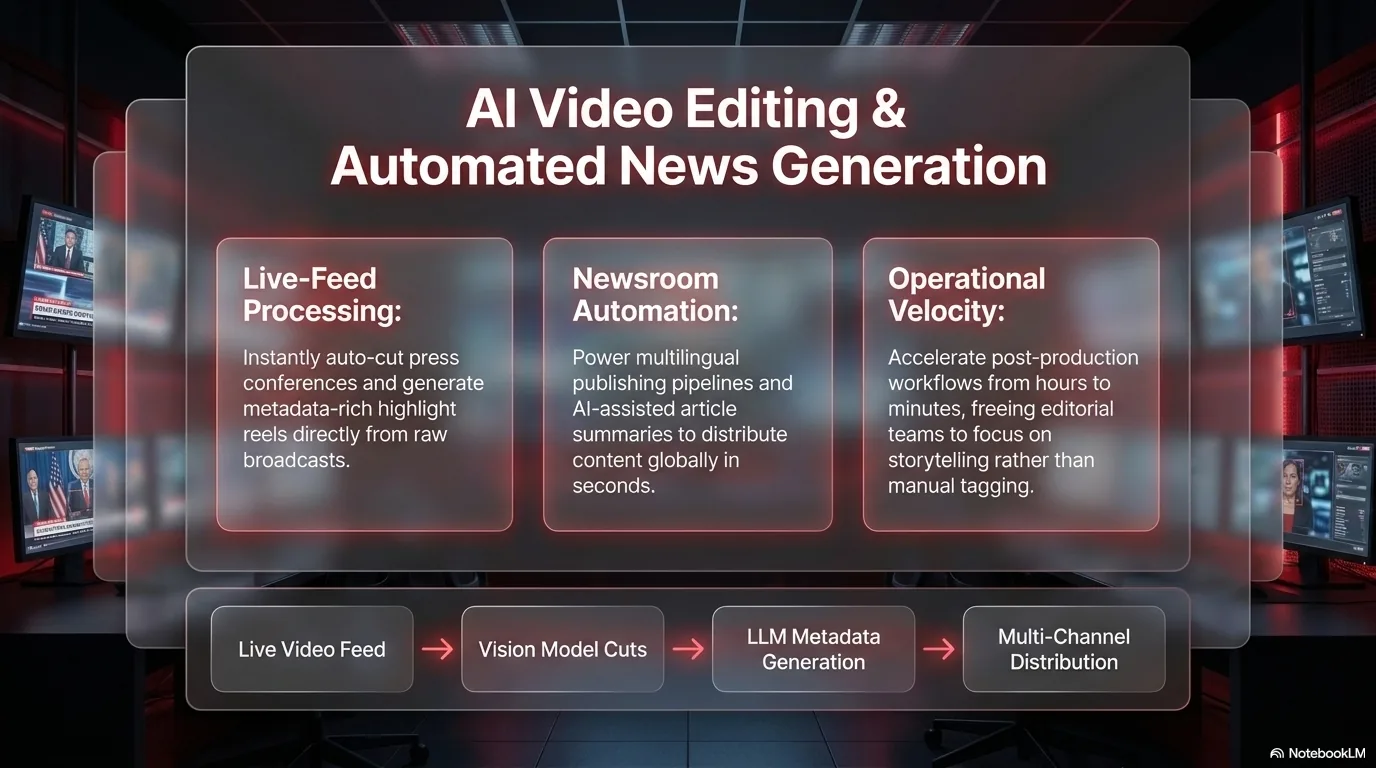
Automated scene detection and clipping - AI models analyze video streams to detect speaker changes, topic shifts, and high-engagement moments. Key statements are automatically timestamped and extracted.
Transcript-driven editing - Speech-to-text combined with NLP identifies quotable segments, questions from journalists, and key announcements. The editor works with a structured summary rather than rewatching footage.
Highlight reel generation - For events like sports or conferences, AI composes short highlight packages automatically, selecting the best moments based on defined rules (crowd noise, speaker prominence, duration).
Live feed processing - Real-time AI pipelines can monitor live feeds and flag moments of interest as they happen, giving editors a jump start before the broadcast is even over.
Video AI is preparation. The editor still cuts; the AI has just made the raw material searchable, structured, and reviewable.
Real-World Example
A national broadcaster piloted an AI video pipeline for daily press conference coverage. The system automatically:
- Transcribed all incoming video feeds
- Identified and timestamped key statements using NLP
- Generated a structured edit list for editors to review
Result: editors went from reviewing full recordings to working from pre-structured edit lists, cutting review time by over 60%. The AI doesn’t replace the editor’s judgment - it removes the tedious part of the job.
What This Looks Like as a Workshop
In a 3-session workshop, we typically:
- Map the current workflow - understand where time is lost and what “good output” looks like
- Build a prototype pipeline - connect a transcription service, NLP layer, and simple UI for editors
- Test with real footage - validate accuracy and editor acceptance before any production commitment
AWS services commonly used: Amazon Transcribe, Amazon Rekognition, AWS Step Functions, S3 for media storage.