
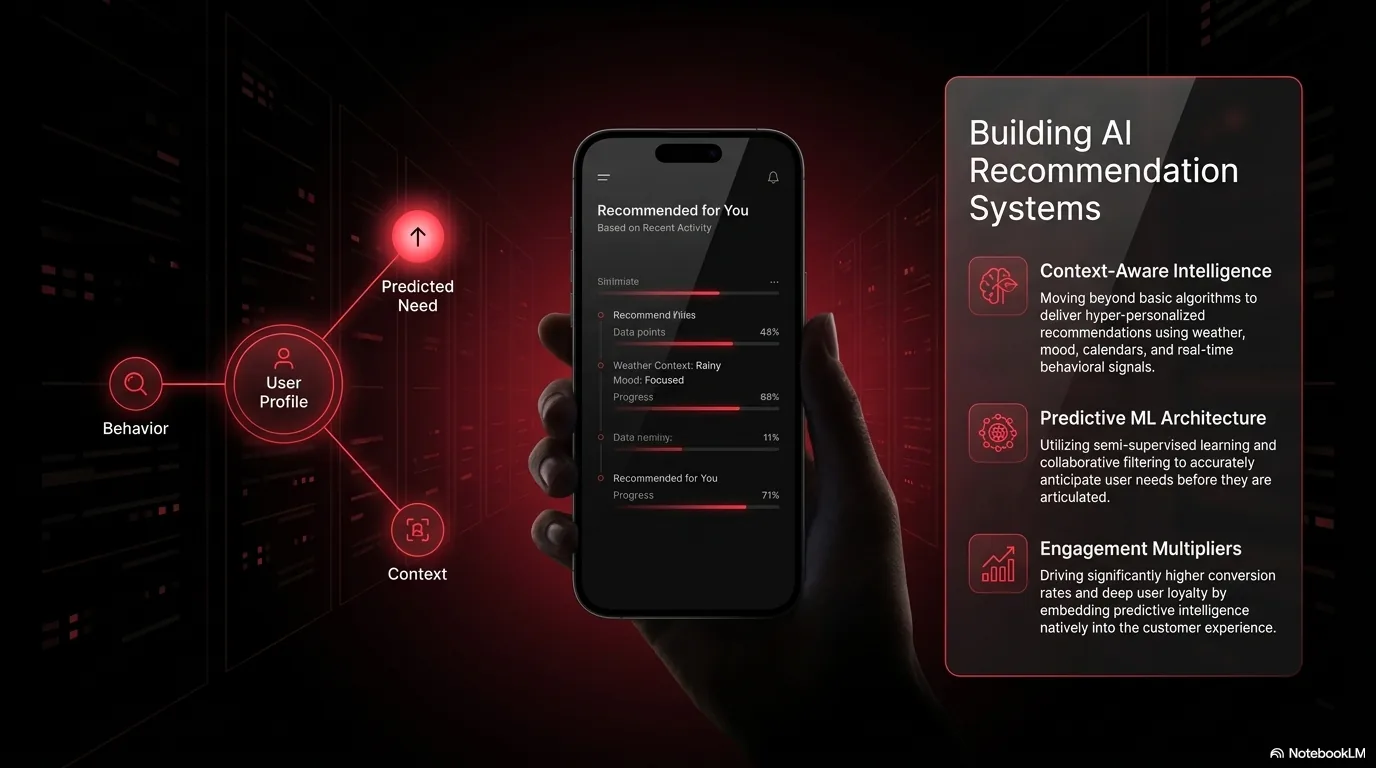
Building AI Recommendation Systems
The Problem
Recommendation systems are one of the highest-ROI applications in digital products - but most organizations either implement them poorly (basic collaborative filtering with outdated approaches) or not at all (static content, manual curation).
The gap between a basic recommendation feature and a truly contextual one is significant. A system that recommends based on past behavior alone misses the moment: what a user wants on a Monday morning is different from what they want on a Friday afternoon.
How AI Solves It
Contextual recommendation - Modern recommendation systems combine multiple data streams: past behavior, explicit preferences, implicit signals (time spent, scroll depth, skipped items), and real-time context (time of day, device, location, calendar, weather).
Embedding-based similarity - Items (products, articles, media) are represented as vectors in semantic space. Recommendations find items nearest to the user’s current preference state - not just items similar to what they clicked last week.
Real-time context integration - External data feeds (weather APIs, calendar data, trending signals) are integrated at inference time, not just at training time. The recommendation shifts based on what is happening now.
Feedback loops - Implicit feedback (what was consumed, for how long, what was skipped) continuously updates the model’s understanding of the user’s preferences without requiring explicit ratings.
Explanation layer - Modern recommendation systems can explain their suggestions: “Because you watched X and it’s Friday evening” rather than a black-box result. This improves user trust and adoption.

Recommendation systems are evaluation infrastructure. The model is the easy part; the measurement framework is the hard part.
Real-World Example
A media platform built a contextual recommendation prototype for editorial content. The system combined:
- Reading history and topic preferences
- Time of day and day of week signals
- Trending topics within the user’s location
- Editorial priority weighting
The prototype, built over 3 weeks, demonstrated a 28% improvement in content engagement metrics compared to the existing chronological feed in A/B testing.
What This Looks Like as a Workshop
Recommendation system workshops begin with mapping the available signals (what data exists) and the recommendation surface (where will recommendations appear). We build a prototype that demonstrates contextual recommendations with real data before any production investment.
AWS services commonly used: Amazon Personalize (for managed recommendation models), Amazon Bedrock (for semantic understanding), DynamoDB for user preference storage, and EventBridge for real-time signal processing.