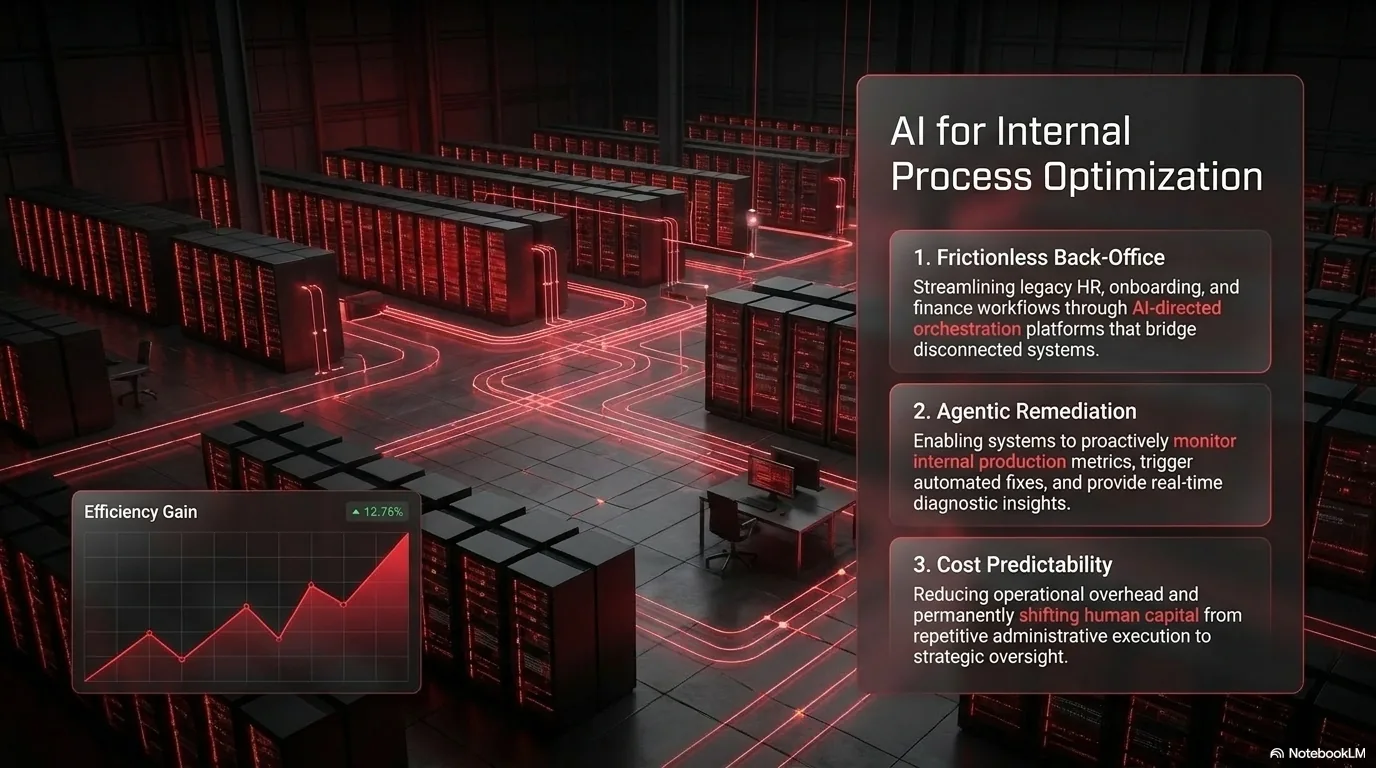
AI for Internal Process Optimization
The Problem
Internal processes are often the last to benefit from AI investment. Customer-facing applications get the attention, while back-office teams continue to copy data between systems, chase approvals via email, and onboard new employees with 20-step manual checklists.
The irony is that internal process automation often has some of the highest ROI - the processes are well-defined, the data is controlled, and the time savings are immediate and measurable.
How AI Solves It
Employee onboarding automation - New hire onboarding involves dozens of steps across HR, IT, facilities, and the hiring manager. AI-driven workflow automation coordinates these steps, sends the right documents to the right people at the right time, tracks completion, and escalates when steps are delayed.
Document processing and routing - Incoming documents (invoices, contracts, expense reports, purchase orders) are automatically classified, key data extracted, and routed to the appropriate approver or system - without human intake work.
Intelligent form processing - Forms submitted internally (vacation requests, expense approvals, equipment orders) are validated, enriched with context data, and processed without manual data entry.
Process bottleneck detection - AI analysis of workflow logs can identify where processes consistently stall, which steps have the highest error rate, and where automation would have the greatest impact.
Knowledge base automation - Internal wikis and documentation become searchable through natural language queries. Instead of “search the intranet for the procurement policy”, employees ask a question and get a direct answer with a source reference.

Internal AI is workflow infrastructure. The work that humans actually do gets faster; the work humans should not do disappears.
Real-World Example
An enterprise organization piloted AI-assisted onboarding for a specific department. The system:
- Triggered the 23-step onboarding checklist automatically when a new hire was confirmed in the HR system
- Sent relevant tasks to each responsible party with automated follow-up
- Gave the new hire a self-service status view
- Reduced average onboarding completion time from 3 weeks to 8 days
- Reduced HR administrative time per hire by approximately 4 hours
The prototype used Amazon Step Functions for workflow orchestration and Amazon Textract for document processing.
What This Looks Like as a Workshop
Internal process automation workshops typically start with one high-friction process (onboarding, invoice processing, or procurement) and build a working automation prototype. The goal is to demonstrate measurable time savings before scaling to other processes.
AWS services commonly used: AWS Step Functions, Amazon Textract, Amazon Bedrock (for document understanding), SNS for notifications, and DynamoDB for state management.