
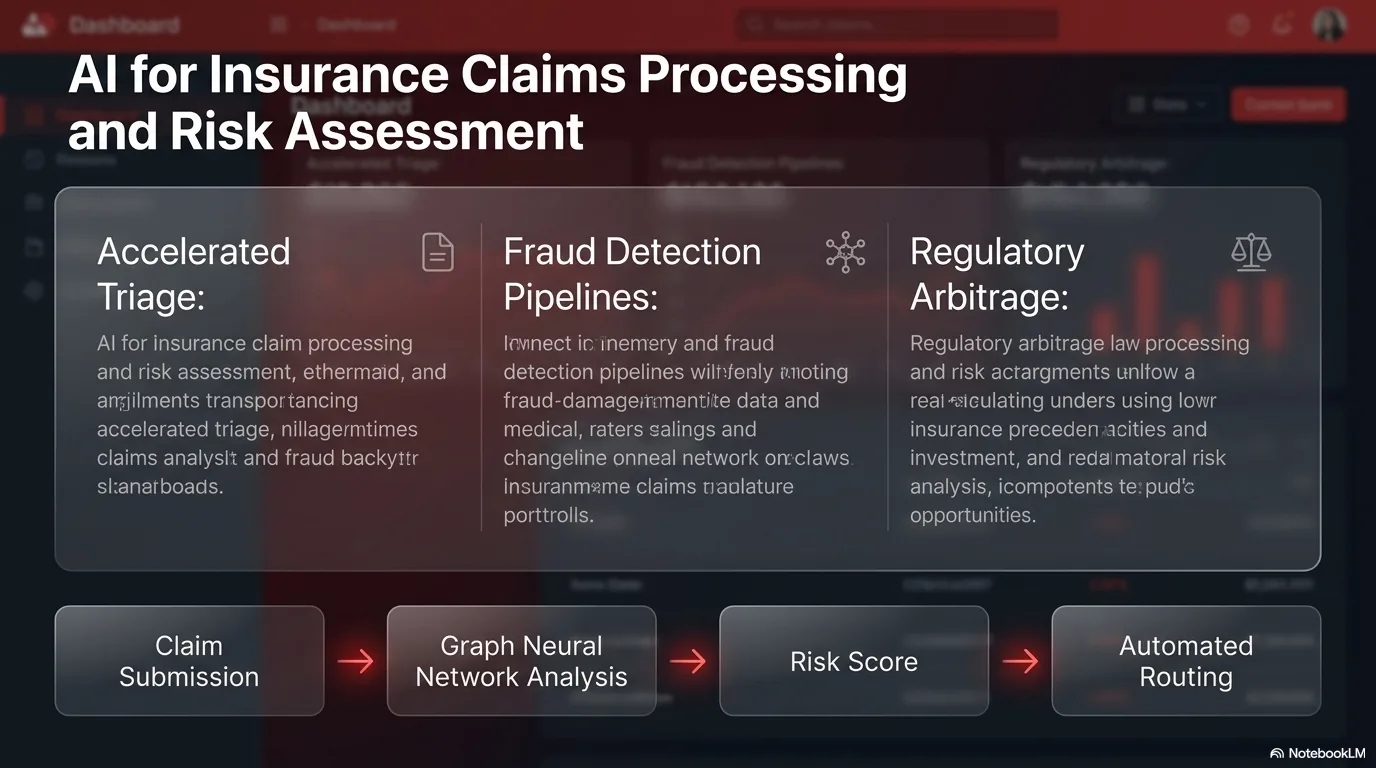
AI for Insurance Claims Processing and Risk Assessment
The Problem
Insurance operations are document-heavy and decision-intensive. A single claims file might include the initial claim form, supporting documentation, third-party reports, photos, medical records, and correspondence - all in different formats, from different sources.
Claims adjusters spend a significant portion of their time on information gathering and data entry rather than the actual judgment work: assessing validity, calculating settlement, and managing complex cases. This creates backlogs, inconsistency, and high operational costs.
How AI Solves It
Intelligent document extraction - AI reads and structures incoming documents regardless of format (PDF, scanned paper, email). Claim details, dates, amounts, and parties are extracted automatically and populated into the claims system.
Automated risk scoring - New claims are automatically scored against historical patterns: type of claim, claimant history, reported circumstances, geographic factors. Adjusters see a risk profile before they open the file.
Fraud detection signals - AI identifies patterns associated with fraudulent claims - inconsistencies in documentation, unusual claim timing, network patterns (multiple claims from related parties). These signals feed into the adjuster’s workflow, not replace their judgment.
Straight-through processing - Low-complexity, low-risk claims meeting defined criteria can be automatically approved and paid without adjuster review. This dramatically reduces the volume of claims requiring human attention.
Adjuster decision support - For complex cases, AI summarizes the claim file, highlights key risk factors, and surfaces relevant precedents - giving the adjuster a structured brief instead of a stack of documents.

Insurance AI works as a closed loop. The signal that the human reviewer provides feeds back into the model the same week.
Real-World Example
An insurance company piloted automated claims document extraction for a category of standard claims. The system:
- Extracted structured data from claims documents with over 90% accuracy
- Reduced average claims intake processing time by over 70%
- Freed adjuster time for complex case investigation
- Improved data consistency across the claims database
The prototype was built and validated in a 3-week workshop engagement, with a production roadmap defined before the engagement closed.
What This Looks Like as a Workshop
Insurance AI workshops typically start with document extraction (the most immediate ROI) and then expand to risk scoring and fraud detection in subsequent phases. We work with sample claims data (anonymized) to validate accuracy before any production deployment.
AWS services commonly used: Amazon Textract for document extraction, Amazon Comprehend for text analysis, Amazon Bedrock for complex reasoning and summarization, and Step Functions for workflow orchestration.