
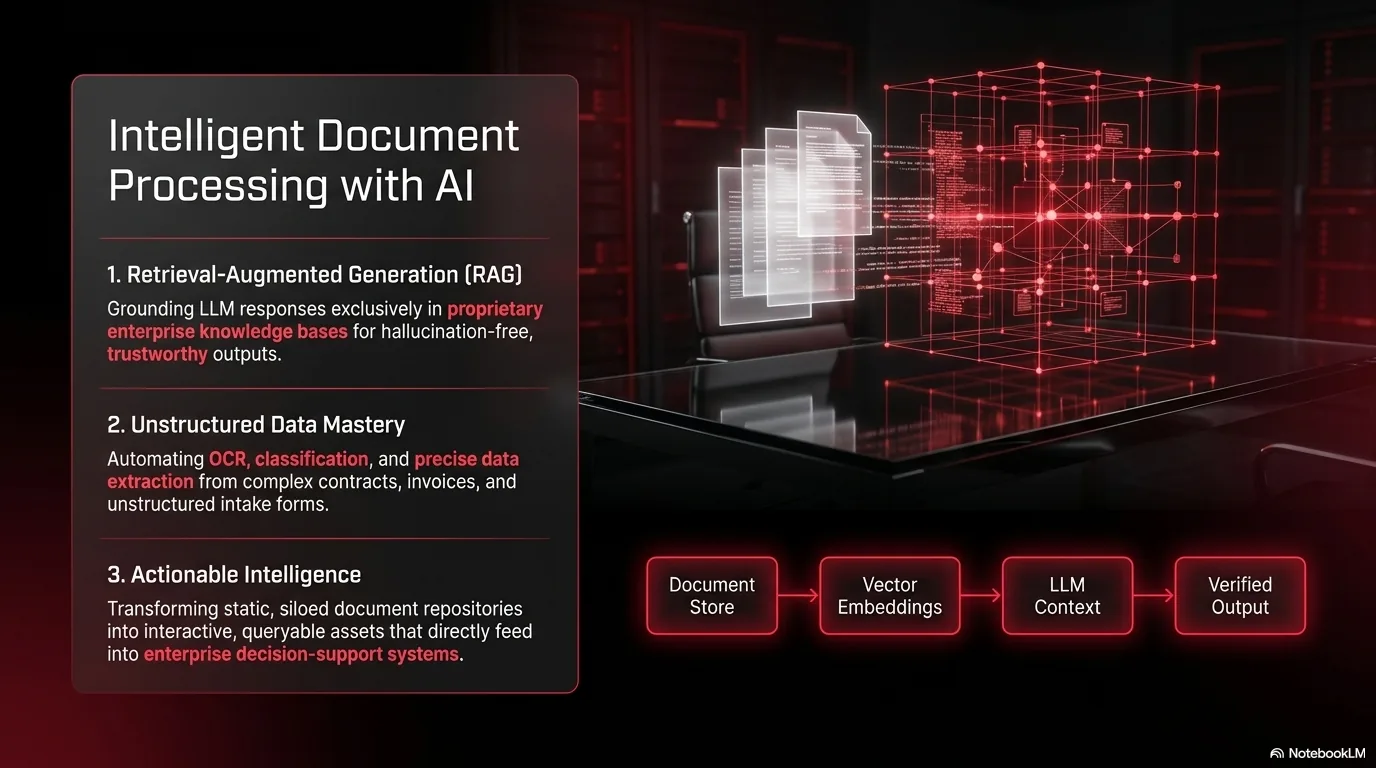
Intelligent Document Processing with AI
The Problem
Documents are everywhere in enterprise operations - contracts, invoices, purchase orders, expense reports, insurance forms, medical records, compliance filings. And despite decades of digital transformation, most organizations still have humans reading these documents and typing data into systems.
This manual process is slow, expensive, error-prone, and deeply frustrating for the people doing it. It is also one of the easiest categories of work to automate with modern AI.
How AI Solves It
Optical Character Recognition (OCR) - Modern OCR goes far beyond scanning text. It understands document layout, distinguishes tables from paragraphs, handles handwriting, and processes poor-quality scans that would defeat traditional OCR tools.
Document classification - Incoming documents are automatically classified by type (invoice, contract, expense report, etc.) before any extraction logic is applied. This allows different extraction rules for different document types without manual routing.
Structured data extraction - AI identifies and extracts specific fields from unstructured documents: invoice number, vendor name, line items, total amount, due date. The output is structured data ready for database ingestion - not a PDF someone has to re-read.
Table extraction - Financial statements, rate sheets, and comparison tables can be extracted as structured data, enabling downstream calculation and analysis without manual entry.
Validation and confidence scoring - Each extracted field comes with a confidence score. Low-confidence extractions are flagged for human review; high-confidence extractions proceed automatically. This creates a hybrid workflow that optimizes for both speed and accuracy.
Cross-document reasoning - For complex cases (e.g., verifying that an invoice matches a purchase order matches a delivery receipt), AI can compare across multiple documents and flag discrepancies automatically.

Document AI is precision engineering. Confidence scoring is what makes the hybrid human-AI workflow possible.
Real-World Example
A financial services firm processed approximately 3,000 invoices per month, each requiring manual data entry into their accounting system. The process was handled by a team of 4 people spending roughly half their time on this task.
The AI document processing pilot:
- Processed all incoming invoices automatically within 2 minutes of receipt
- Extracted structured data with 94% accuracy
- Routed low-confidence cases (6% of invoices) to human review with the extracted data pre-filled
- Reduced total team time on invoice processing by 80%
The prototype was built and validated in 3 weeks. Production deployment followed 6 weeks later.
What This Looks Like as a Workshop
Document processing workshops start with your highest-volume, most structured document type. We build a prototype extraction pipeline, test accuracy on real documents, and define the human review workflow for edge cases.
AWS services commonly used: Amazon Textract (for OCR and structured extraction), Amazon Comprehend (for entity recognition and classification), S3 for document storage, Step Functions for workflow orchestration, and Bedrock for complex reasoning on ambiguous documents.