AI Audio Analysis and Automated Editing
The Problem
Film and broadcast productions routinely record audio on multiple tracks - lapel mics, boom mics, room mics. In post-production, an audio editor manually reviews all tracks, selects the best source for each moment, and blends as needed. For a 90-minute documentary with 6 subjects, this can mean days of audio work.
The same problem occurs in podcast production, corporate video, and live event recording: multiple inputs, variable quality, and the tedious human work of track selection and cleanup.
How AI Solves It
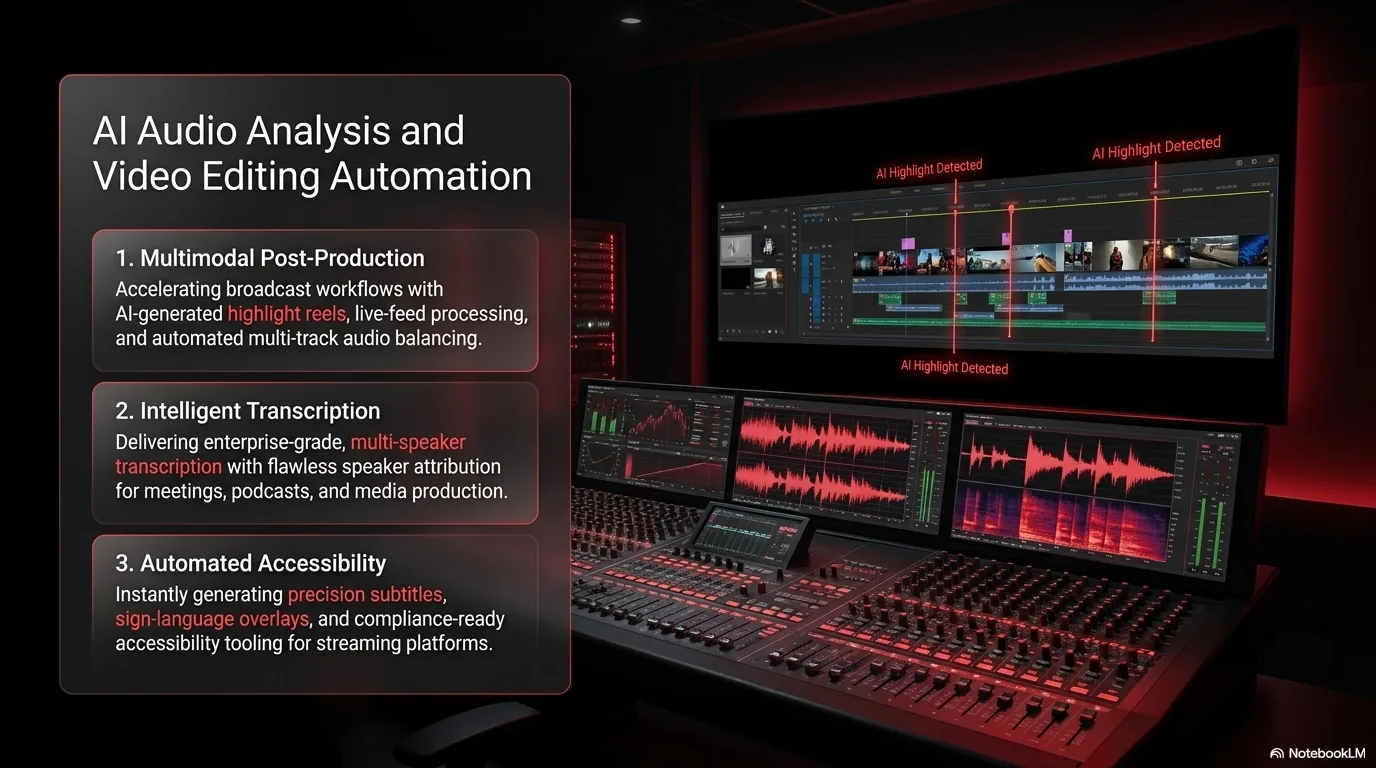
Automated track selection - AI models analyze each audio track in real time, scoring for clarity, noise level, clipping, and proximity. The system automatically selects the optimal source for each moment, building an edit decision list (EDL) that editors can review and adjust rather than create from scratch.
Background noise classification - AI distinguishes between desirable room tone, unwanted noise (HVAC, paper rustling, camera movement), and speech. This enables automated cleanup that is more accurate than simple noise reduction filters.
Speaker isolation - Multi-speaker recordings can be automatically separated by speaker, producing clean stems for individual processing - compression, EQ, volume normalization.
Quality flagging - Rather than listening to every second of a long recording, editors receive a flagged timeline: “potential clipping at 4:22”, “mic handling noise at 12:07”, “low confidence source at 38:44”. Review time drops dramatically.

Audio analysis at scale starts with disciplined capture and ends with structured signal the downstream systems can act on.
Real-World Example
A broadcast production team piloted AI audio analysis for a documentary series. Each episode had 4-6 subjects recorded with dual-microphone setups. The AI pipeline:
- Analyzed all tracks and produced an automated track selection per segment
- Flagged 23 specific moments requiring human review (out of 90 minutes of audio)
- Reduced audio editor review time by approximately 65%
The editors reported that the AI selections were correct in roughly 90% of cases without adjustment - the 10% edge cases were exactly the situations where human judgment was most needed anyway.
What This Looks Like as a Workshop
Audio AI workshops start with a sample of real production audio. We test automated analysis, validate output quality against editor judgment, and build a prototype pipeline that fits the existing post-production workflow.
AWS services commonly used: Amazon Transcribe (for speech segmentation), S3 for audio asset storage, Lambda for processing orchestration, and custom SageMaker models where specialized audio classification is needed.