AI-Powered Accessibility for Media
The Problem
Accessibility requirements for digital media are increasing across regulatory frameworks in Europe and beyond. Broadcasters and streaming platforms must provide subtitles, audio descriptions for visually impaired viewers, and increasingly, sign language overlays.
The challenge is volume. A broadcaster producing 18+ hours of content per day cannot manually subtitle every piece of content without massive teams and significant cost. Existing manual workflows create delays, inconsistency, and coverage gaps.
How AI Solves It
AI accessibility automation addresses each layer:
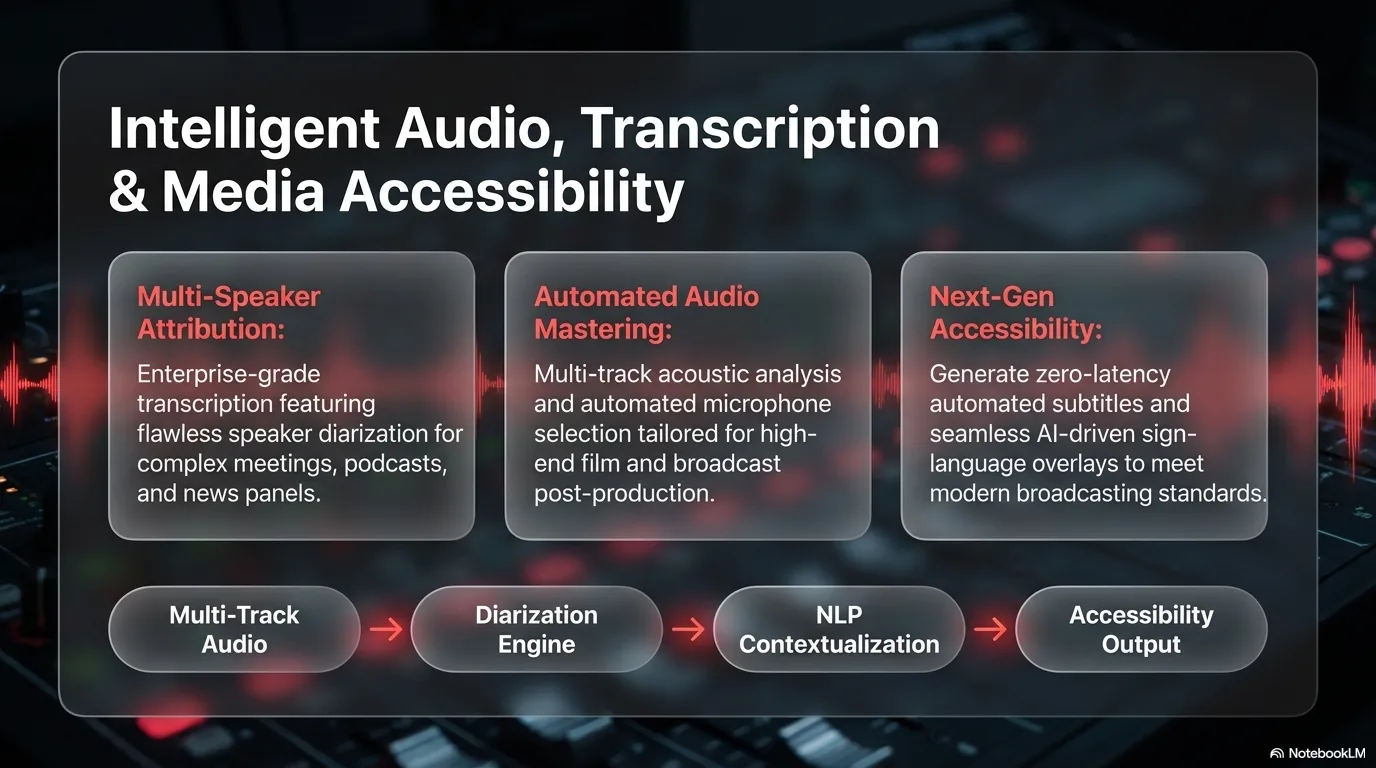
Automated subtitling - Speech-to-text models generate subtitle files (SRT/VTT) automatically. Modern models handle accents, technical vocabulary, and fast speech with high accuracy. Human review time drops from full transcription to light editing.
Audio descriptions - AI vision models can describe visual scenes, on-screen text, and action sequences. Combined with TTS (text-to-speech), this produces audio description tracks that can be layered onto existing content.
Sign language overlay - More advanced implementations use generative AI to drive virtual signing avatars, synchronized to the spoken content. While this technology is still maturing, pilot implementations are running in production at several European broadcasters.
Quality assurance automation - Beyond generation, AI can also verify that existing captions are synchronized correctly, flag segments with low confidence, and prioritize human review where it matters most.

Accessibility AI is augmentation, not replacement. The human reviewer remains the accountable layer for the lived experience.
Real-World Example
A national broadcaster piloted AI subtitle generation for a subset of their archive and live content. The system:
- Generated subtitles automatically for all new content at upload time
- Flagged low-confidence segments for human review
- Reduced the per-minute cost of subtitling by over 70%
- Achieved regulatory compliance faster than the manual baseline
The human editors shifted from transcription work to quality review - a more sustainable and skilled role.
What This Looks Like as a Workshop
Accessibility automation workshops typically start with the highest-volume, highest-urgency use case (usually subtitling), build a working prototype with real content, and then map the path to scaling across the full content library.
AWS services commonly used: Amazon Transcribe, Amazon Polly (for TTS audio descriptions), S3, MediaConvert, and CloudFront for delivery.